Voicemail is free but passive: it records a message and waits for you to act. An AI voice receptionist answers the call, asks the questions you’d ask and books the job or sends you the details. Voicemail is fine for quiet, non-urgent lines. An AI receptionist is better where a missed call is a missed job.
Key takeaways
- Voicemail costs nothing but depends on the caller leaving a message and you ringing back quickly.
- In our test, 63% of connected calls to trades businesses went to voicemail.
- An AI voice receptionist answers, takes details and books into your calendar from $297 a month including GST.
- Voicemail is still a sensible choice for some lines. We say when.
Most small businesses start with voicemail. It’s already on your phone, it costs nothing and it’s better than a dead line. That’s a fair reason to use it, and for some businesses it’s enough.
But the question isn’t whether voicemail is better than nothing. It is. The question is whether it’s the best use of the calls you can’t get to. Here’s an honest comparison.
What each one does
Voicemail plays a greeting and records whatever the caller says, if they choose to say anything. You listen later and decide what to do.
An AI voice receptionist answers the call itself. It talks with the caller, asks the questions you’d ask (name, number, suburb, what’s wrong, how urgent), and then books a time in your calendar or sends you the details. Emergencies are passed to a real person, and if nobody is free each side gets a text with the other’s contact details.
Side by side
| Voicemail | AI voice receptionist | |
|---|---|---|
| Cost | Free | $495 setup, then $297 a month including GST |
| Answers the call | No, plays a greeting | Yes, talks with the caller |
| Caller has to do | Decide to leave a clear message | Just talk |
| Details you get | Whatever the caller says | The same useful questions, every call |
| Books the job | No | Yes, into your calendar |
| After hours | Records a message | Answers and books |
| Urgent calls | Wait until you listen | Passed to a real person |
| Best at | Quiet, low-urgency lines | Calls you can’t afford to miss |
The pattern is simple. Voicemail pushes all the work onto the caller and onto you later. A receptionist, human or AI, takes that work on at the moment of the call.
What our test calls showed
Between Monday 23 and Friday 27 November 2026 we placed test calls to the published numbers of plumbers, electricians and air-conditioning businesses in Adelaide, Melbourne and Sydney: one call in a busy weekday-morning window and one after hours. We only counted calls that connected, meaning a person answered, it went to voicemail, or it rang out. Calls that failed, hit a busy tone or couldn’t be classified are left out of every number. Whether a person or an answering machine picked up was detected automatically, so treat the percentages as close estimates, and treat the smaller trade samples with care.
Of 412 connected calls, 259 (63%) went to voicemail and 39 (9%) rang out. A person answered 114 (28%).
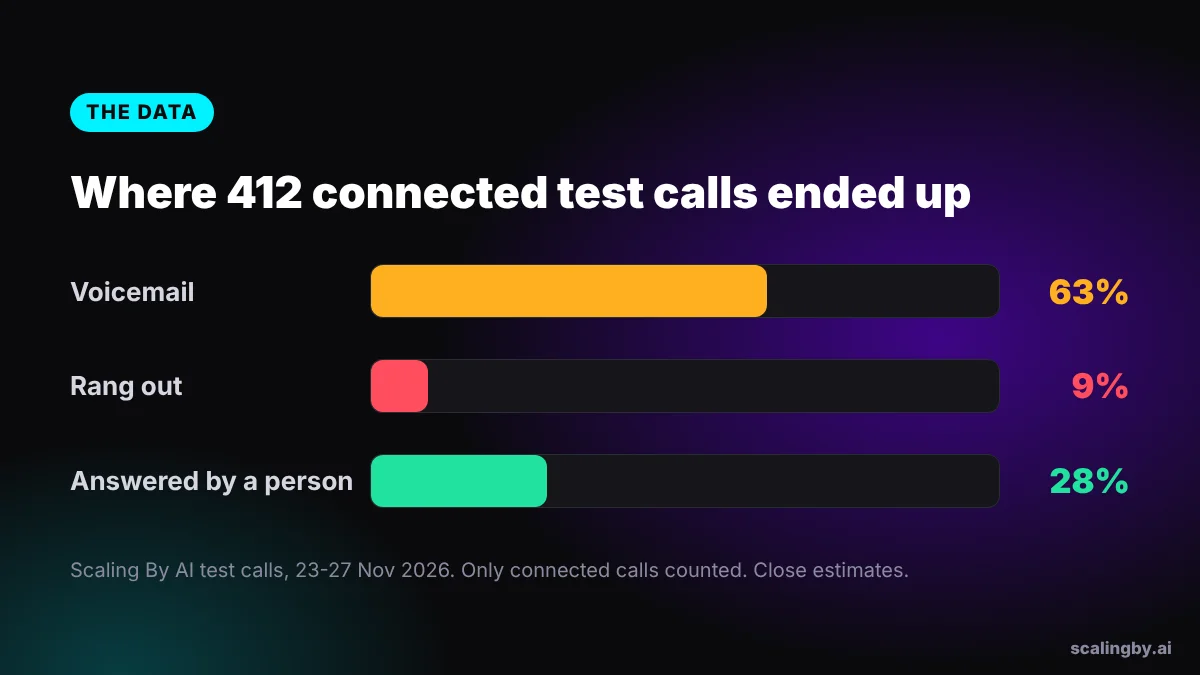
That means voicemail was the main way these businesses handled calls they couldn’t answer. We can’t see how many callers left a message. Our concern is the callers who didn’t, and the ones who did but heard back too late.
Test calls placed by Scaling By AI, 23 to 27 November 2026, to published business numbers in Adelaide, Melbourne and Sydney. We can’t see what callers did after reaching voicemail, so this shows where calls ended up, not jobs lost.
When is voicemail still the right choice?
- Mostly repeat customers. If almost everyone who rings already knows you, a clear greeting and a prompt call back may be all you need.
- A quiet line. If you get a handful of calls a week and none are urgent, an extra service may not pay for itself.
- You’re always near the phone. If the line is covered during every working hour and after hours isn’t a problem, voicemail is only the backup.
If that’s you, keep voicemail and make it better: record a greeting saying you’re on a job, say when you’ll ring back and give a mobile to text.
When does an AI receptionist win?
- New customers find you on Google. They call several businesses and go with the first that helps.
- Emergencies and after-hours work. The calls that matter most tend to arrive when you can’t answer.
- You’re on the tools all day. Every call you can’t take is a decision you’ve already made by default.
- You lose time to phone tag. Booking at the first call removes the back and forth.
It isn’t magic and it isn’t a person. It only knows what it’s been taught about your business, which is why we build each one around your services and rules. And quotes and unusual jobs are still yours.
What does it cost to switch?
Alex, our AI voice receptionist, is $495 to set up and $297 a month, including GST, with the first month included in the setup fee. The dedicated Australian number is included in the monthly fee. There’s no contract and you can cancel any time, effective at the end of your current period. Once we have your business details it typically goes live within 2 business days.
If you’d prefer the first reply to be a text, missed-call text-back is $397 to set up and $159 a month. The two can’t run on the same number, so voice is the upgrade.
Our live demo is set up as a plumbing business and a tree service. Ring it, pretend to be a customer with a problem, and hear what your callers would hear. No sign-up, no card.
Hear the live demoFrequently asked questions
Is an AI receptionist better than voicemail?
For calls you can’t afford to miss, usually yes, because it answers and books the job instead of waiting for a message. For quiet, non-urgent lines, voicemail can be enough.
Will callers hang up on an AI receptionist?
Some callers prefer a person, and that’s fair. The best test is to hear it yourself, so try our live demo and decide how your own callers would find it.
Can I keep my voicemail as well?
You can keep your normal voicemail for calls you don’t route to the receptionist. You choose whether calls go to it straight away or only when you miss them.
How much does an AI voice receptionist cost?
$495 to set up and $297 a month including GST, with the first month included in the setup fee. No contract.
What happens with emergencies?
Emergency calls are passed to a real person. If nobody is free, each side receives a text with the other’s contact details.
Sources
- Scaling By AI test calls, 23 to 27 November 2026 (412 connected calls to 257 plumbing, electrical and air-conditioning businesses in Adelaide, Melbourne and Sydney; calls up to 10:30am on 27 November)
- Scaling By AI service terms and pricing (AUD, including GST)
This article is general information, not legal or financial advice.