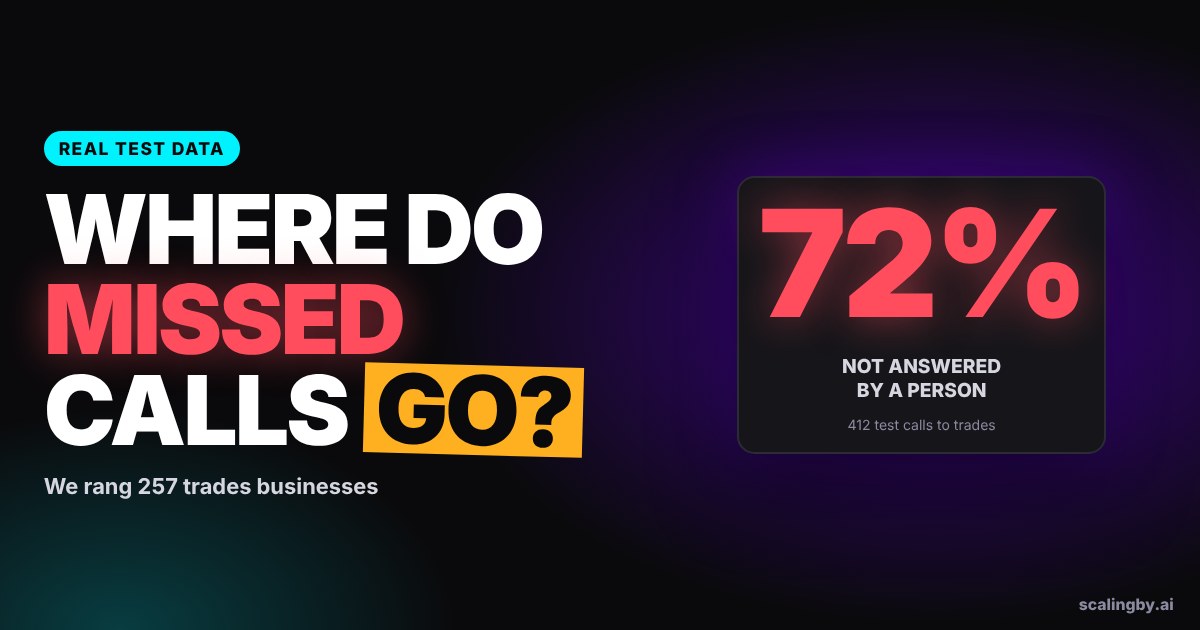
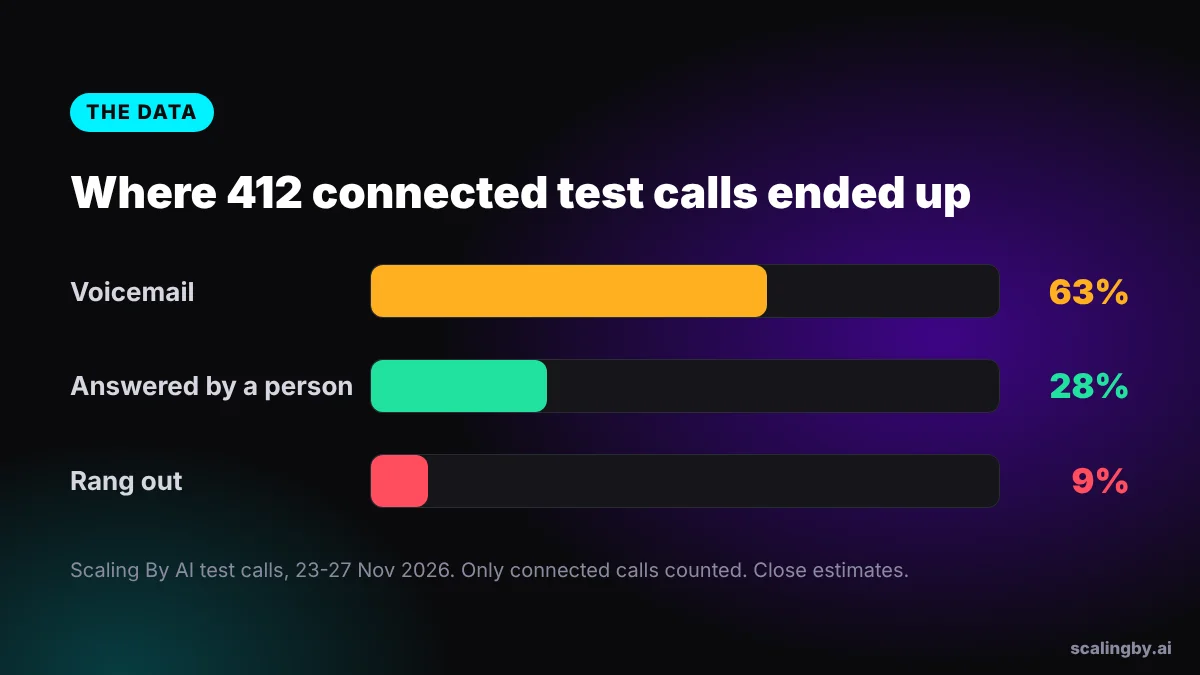
In our test, most missed calls ended up in voicemail: of 412 connected calls to trades businesses, 63% went to voicemail, 9% rang out with no answer and 28% were answered by a person. Voicemail only helps if the caller is willing to leave a message and wait.
Key takeaways
- 28% of connected test calls were answered by a person; 63% hit voicemail; 9% rang out.
- A call that rings out never even leaves a message, so you never know it happened.
- A caller shopping around often moves on to the next business instead of leaving a message.
- Fix the first ten seconds and you change what happens to every other call.
You glance at your phone after a job and see two missed calls. One is a number you know. The other isn’t. You think about ringing back, then you get pulled into the next thing.
But where did that second call actually go while you weren’t looking? We decided to find out from the other side of the line, by ringing a few hundred trades businesses and recording what happened.
What we did
Between Monday 23 and Friday 27 November 2026 we placed test calls to the published numbers of plumbers, electricians and air-conditioning businesses in Adelaide, Melbourne and Sydney: one call in a busy weekday-morning window and one after hours. We only counted calls that connected, meaning a person answered, it went to voicemail, or it rang out. Calls that failed, hit a busy tone or couldn’t be classified are left out of every number. Whether a person or an answering machine picked up was detected automatically, so treat the percentages as close estimates, and treat the smaller trade samples with care.
Two things to keep in mind. First, we’re a business selling an AI receptionist, so we have an interest in this topic, and we’ve tried to be careful about what we claim. Second, we can’t see inside anyone’s business: this tells you what a caller experiences, not what happened afterwards.
The three places a call goes
| Outcome | Calls | Share |
|---|---|---|
| Answered by a person | 114 | 28% |
| Went to voicemail | 259 | 63% |
| Rang out, no answer | 39 | 9% |
1. It goes to voicemail (63%)
This is where most calls land. Voicemail isn’t useless, and plenty of existing customers will leave a message. But think about the caller who has a blocked drain on a Sunday and has just searched “emergency plumber near me”. They have a short list of businesses and a problem that can’t wait. Leaving a message and hoping is the weakest option on that list.
2. It rings out (9%)
No answer, no voicemail, nothing. From the business’s side there is no trace of the call unless the number shows up in a missed-call list. From the caller’s side it’s a dead end, so they ring someone else.
3. A person answers (28%)
Fewer than three in ten. And the people who did answer were doing the right thing: picking up when they could. The problem isn’t attitude. It’s that nobody can be on the tools and on the phone at once.
Test calls placed by Scaling By AI, 23 to 27 November 2026, to published business numbers in Adelaide, Melbourne and Sydney. We can’t see what callers did after reaching voicemail, so this shows where calls ended up, not jobs lost.
Does the time of day change where calls go?
It does, and not in the way you might expect. In a busy weekday-morning window, 235 connected calls were split 34% answered, 59% voicemail and 7% rang out. After hours, 177 connected calls were 19% answered, 68% voicemail and 12% rang out.
| When we called | Answered by a person | Voicemail | Rang out |
|---|---|---|---|
| Busy weekday morning (235 calls) | 34% | 59% | 7% |
| After hours (177 calls) | 19% | 68% | 12% |
So even at peak working time, two thirds of calls weren’t answered by a person. After hours, it’s about four in five. A lot of customers ring in the evening, when they’re home and finally have time to sort out the job.
Does it vary by trade?
| Trade | Businesses | Connected calls | Answered by a person | Not answered |
|---|---|---|---|---|
| Plumbers | 192 | 284 | 26% | 74% |
| Electricians | 45 | 90 | 30% | 70% |
| Air conditioning | 20 | 38 | 32% | 68% |
The pattern is similar across the three. The air-conditioning figure rests on just 38 calls, so read it as a rough guide. What stands out isn’t the difference between trades. It’s how similar they are.
What does a missed call really cost?
We can’t tell you what each of those calls was worth, because we don’t know what the callers would have done. But you can work out your own number in a few minutes:
- Count your missed calls in a normal week from your phone’s call log.
- Estimate how many of them were new customers rather than people you already know.
- Multiply by the average value of one job.
- Be honest about how many would genuinely have booked. Half? A quarter?
Even a modest answer adds up over a year. A single missed job worth a few hundred dollars every week is a five-figure number, and that’s before repeat business and referrals.
Not every missed call is a lost job. Some are wrong numbers, sales calls or people who ring back. The point isn’t that every ring is money. It’s that you can’t tell which ones were, if nobody answers.
How do you change where the calls go?
- Answer faster. An AI voice receptionist picks up straight away, takes the details and books the job into your calendar. See how it works.
- Reply instantly by text. A missed-call text-back texts the caller within moments if you don’t pick up.
- Tighten the free stuff. Match your Google Business Profile hours to when you really answer, and put your mobile on the voicemail greeting.
- Don’t run text-back and the voice receptionist on the same number. They both cover it, so choose one.
Our live demo is set up as a plumbing business and a tree service. Ring it, pretend to be a customer with a problem, and hear what your callers would hear. No sign-up, no card.
Hear the live demoFrequently asked questions
Where do missed calls go?
In our test of 412 connected calls to trades businesses, 63% went to voicemail, 9% rang out with no answer and 28% were answered by a person.
Do missed callers leave voicemails?
Some do, especially existing customers. A caller who is comparing businesses for an urgent job often moves on to the next one instead. We can’t see what individual callers did, so this is a risk, not a measured loss.
How did you measure it?
We placed test calls to published business numbers in Adelaide, Melbourne and Sydney in a weekday-morning window and after hours. Only calls that connected were counted. Whether a person or voicemail answered was detected automatically, so the percentages are close estimates.
Is 28% answered a normal figure?
It’s the figure from our sample of 257 trades businesses and isn’t a national statistic. Your own call log is the best guide for your business.
How can I make sure calls are answered?
Use something that answers every call: a receptionist, an answering service, an AI voice receptionist or an instant missed-call text-back. Our AI voice receptionist is $495 to set up and $297 a month including GST.
Sources
- Scaling By AI test calls, 23 to 27 November 2026 (412 connected calls to 257 plumbing, electrical and air-conditioning businesses in Adelaide, Melbourne and Sydney; calls up to 10:30am on 27 November)
- Scaling By AI service terms and pricing (AUD, including GST)
This article is general information, not legal or financial advice.