An AI voice receptionist is software that answers your business phone, talks with the caller in natural spoken language, asks the questions you’d ask, then books the job or sends you the details. It works around the clock, so a call that arrives while you’re up a ladder still gets answered.
Key takeaways
- It answers inbound calls in a natural voice, takes the caller’s details and can book straight into your calendar.
- You choose whether it answers every call or only the ones you miss.
- In our test of 412 connected calls to trades businesses, about 72% were not answered by a person.
- Emergency calls can be passed to a real person, and if nobody is free both sides get a text with each other’s contact details.
- Ours is built around your own business rules, and typically goes live within 2 business days of receiving your details.
If you run a trade or a local service business, you already know the problem. The phone rings while your hands are full, you let it go, and you tell yourself you’ll call back at smoko. Sometimes you do. Sometimes the customer has already rung the next business on the list.
An AI voice receptionist is one way to fix that. This guide explains what it is, how a call flows through it, what it can and can’t do, and what it costs. I’ve also put in some numbers from our own test calls, because the size of the problem is easier to see than to argue about.
How does an AI voice receptionist work?
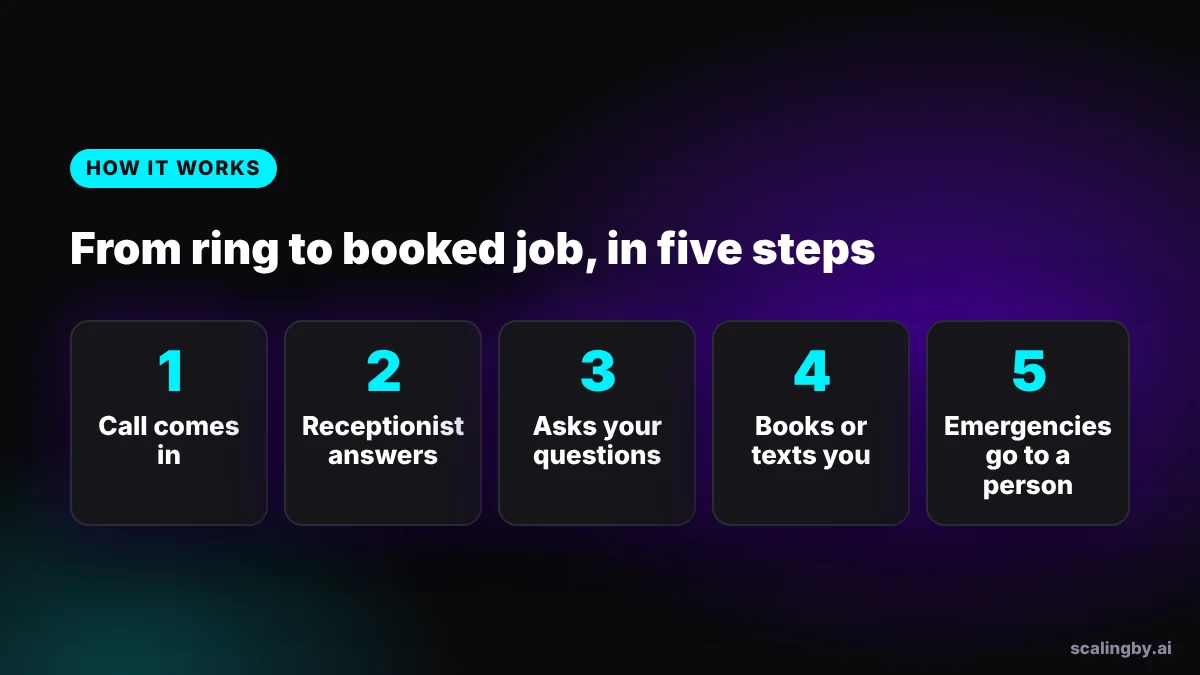
Strip away the jargon and a call goes through five steps.
- A call comes in. It reaches the receptionist on its own dedicated Australian number. You decide whether calls go to it straight away or only when you don’t pick up.
- It answers and listens. The caller speaks normally. The system turns their speech into text, works out what they need, and replies in a spoken voice.
- It asks what you’d ask. Name, number, suburb, what the problem is, how urgent it is. The questions and the rules come from your business, not from a generic script.
- It books or hands over. If the job fits your rules, it books a time in your calendar. If not, it sends you the details by text so you can decide.
- It handles the urgent ones differently. Emergency calls go to a real person. If nobody is free, each side gets a text with the other’s contact details so they can connect directly.
None of that needs you to be near the phone. That’s the whole point.
How big is the missed-call problem for trades?
Opinions on this are cheap, so we measured it. Between Monday 23 and Friday 27 November 2026 we placed test calls to the published numbers of plumbers, electricians and air-conditioning businesses in Adelaide, Melbourne and Sydney: one call in a busy weekday-morning window and one after hours. We only counted calls that connected, meaning a person answered, it went to voicemail, or it rang out. Calls that failed, hit a busy tone or couldn’t be classified are left out of every number. Whether a person or an answering machine picked up was detected automatically, so treat the percentages as close estimates, and treat the smaller trade samples with care.
Of 412 connected test calls, 114 (28%) were answered by a person, 259 (63%) went to voicemail and 39 (9%) rang out. About 72% of calls were not answered by a person.
| When we called | Connected calls | Answered by a person | Not answered by a person |
|---|---|---|---|
| Busy weekday morning | 235 | 80 (34%) | 155 (66%) |
| After hours | 177 | 34 (19%) | 143 (81%) |
Even in the busiest part of the working day, two out of three calls didn’t reach a person. After hours it was four out of five. That’s not a criticism of those businesses. They were doing exactly what you’d expect: working. It just shows how much work walks past the front door unanswered.
| Trade | Businesses | Connected calls | Not answered by a person |
|---|---|---|---|
| Plumbers | 192 | 284 | 74% |
| Electricians | 45 | 90 | 70% |
| Air conditioning | 20 | 38 | 68% (small sample) |
Test calls placed by Scaling By AI, 23 to 27 November 2026, to published business numbers in Adelaide, Melbourne and Sydney. We can’t see what callers would have done after hearing voicemail, so these numbers show calls not answered, not jobs lost.
What can an AI voice receptionist do, and what can’t it?
It’s worth being straight about both sides, because the honest picture is what helps you decide.
What it does well
- Answers every call, every time. Early mornings, evenings, weekends and public holidays, with no sick days.
- Takes consistent details. Every caller is asked the same set of useful questions, so you don’t get a message that just says “call Dave back”.
- Books into your calendar. The job lands in your diary without phone tag.
- Sends texts when the line is busy. The caller gets a reply instead of silence.
- Passes emergencies to a person. Urgent calls aren’t left to a script.
What it doesn’t do
- It doesn’t do the job or give a price on a complicated one. Quotes and unusual requests are still yours to handle.
- It only knows what it’s been taught about your business. That’s why a proper setup matters more than the technology.
- It isn’t a substitute for your judgement. It collects and books. You decide.
AI receptionist vs voicemail vs a human receptionist vs an answering service
| Voicemail | Human receptionist | Answering service | AI voice receptionist | |
|---|---|---|---|---|
| Answers when you’re busy | No, caller must leave a message | Yes, in paid hours | Yes | Yes |
| After hours and weekends | Records a message | Only if rostered | Depends on the plan | Yes, around the clock |
| Books the job | No | Yes | Usually takes a message only | Yes, into your calendar |
| Caller effort | High | Low | Low | Low |
| Best at | Quiet, non-urgent lines | Judgement and a personal touch | Human message-taking | Never leaving a call unanswered |
None of these is wrong for every business. A busy front-of-house receptionist is hard to beat for judgement. A voicemail greeting is fine if the calls are never urgent. The question is what happens to the calls nobody can pick up, and that’s where an AI receptionist earns its place.
What does an AI voice receptionist cost?
Our AI voice receptionist, Alex, is $495 to set up and $297 a month, including GST, with the first month included in the setup fee. There’s no contract. You can cancel any time and the cancellation takes effect at the end of your current period. The dedicated phone number is included in the monthly fee, although the number stays with us if you cancel.
Setup means we learn your services, availability and rules, connect your calendar and provision the number. Once we have your business details, it typically goes live within 2 business days.
Hear it before you decide anything
Our live demo is set up as a plumbing business and as a tree service. Ring it, pretend you’ve got a burst pipe or a branch through the roof, and hear exactly what your own callers would hear. No sign-up, no card.
Hear the live demoYours wouldn’t be a generic script. Every receptionist we build is set up around the business it answers for, with your services, your rules and your way of talking to customers.
Who is it for, and who isn’t it for?
A good fit
- Tradies and local service businesses where the owner is on the tools and calls arrive at awkward times.
- Clinics and other small practices where the front desk can’t always get to the phone.
- Businesses that lose enquiries after hours, on weekends or during storms and busy spells.
Probably not for you
- Businesses that already have someone answering every call, at every hour, with spare capacity.
- Lines where every call needs a long, personal conversation with a person from the first second.
If you’re somewhere in between, the free Local Visibility Audit is a good place to start. It shows how your business appears to the customers searching for you, and where calls are most likely slipping away.
Frequently asked questions
What is an AI voice receptionist?
It’s software that answers your business phone in a natural spoken voice, asks the questions you’d ask, then books the job or sends you the details. It works around the clock and is set up around your own services and rules.
Does an AI voice receptionist sound like a robot?
It uses a synthetic voice designed to sound natural. The best test is to listen for yourself, so try our live demo and judge how your own callers would find it.
Can it book jobs into my calendar?
Yes. It checks your availability and books a time into your calendar, or sends you the details by text if the job needs your call.
What happens with emergency calls?
Emergency calls are passed to a real person. If nobody is available, each side receives a text with the other’s contact details so they can connect directly.
What if it can’t understand a caller?
The caller can always ask to be put through to a human. It can also offer to have a team member reach out, and then texts both the team member and the caller so they can continue the conversation.
Does it take voicemail-style messages?
Its aim is to deal with the call there and then, and book the job where it can. If needed, it can also send a message to pass on to the business.
How many calls can it handle at once?
Up to 10 inbound calls at a time, and capacity can be scaled up at extra cost if you need it.
Do I have to change my phone number?
No. Your receptionist has its own dedicated Australian number. You decide whether calls reach it straight away or only when you miss them.
How long does it take to set up?
Once we have your business details, it typically goes live within 2 business days.
How much does it cost?
$495 setup and $297 a month including GST, with the first month included in the setup fee. No contract, and you can cancel any time.
Sources
- Scaling By AI test calls, 23 to 27 November 2026 (412 connected calls to 257 plumbing, electrical and air-conditioning businesses in Adelaide, Melbourne and Sydney; calls up to 10:30am on 27 November)
- Scaling By AI service terms and pricing (AUD, including GST)
This article is general information, not legal or financial advice.